top of page

Data Loss Prevention for the AI Era

Protect the data not the pipe


Encryption protects data until AI needs to use it. We protect data while AI is using it.


Your people are pasting client names, financials, and source code into AI tools every day.


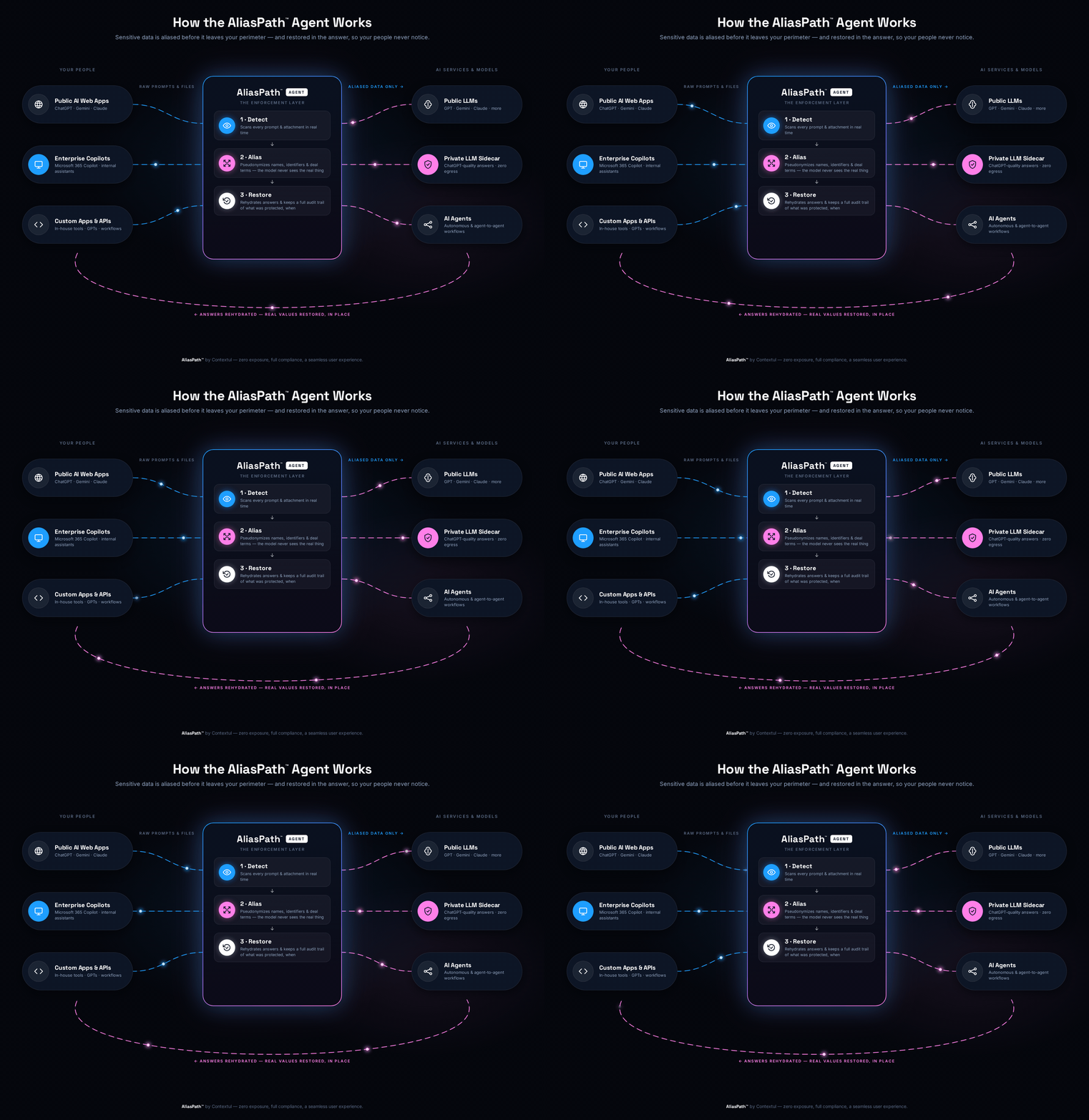
AliasPath™ sits at the verification boundary, replacing real identities with contextual aliases before data ever reaches ChatGPT, Copilot, or any third-party AI. The AI still works.


The real data never leaves.

The Data Leak Doesn't Start With AI. It Starts With Trust

Every calendar sync, every summarized meeting note, and every API call to an LLM creates a tunnel through your firewall. Traditional DLP is blind to the semantic context of these prompts. You aren’t just adopting AI; you are inadvertently exporting your intellectual property


Traditional controls focus on stopping bad traffic. They rarely question why raw identity leaves your environment in the first place. AliasPath™ changes that assumption.

How AliasPath™ Prevents AI Data Loss

Total Control at the Edge

Contextual pseudonymisation

Replace names, addresses and other identifiers with realistic aliases, preserving semantic meaning for AI and processors while keeping real identities inside your trust boundary.

Verification-boundary control

Enforce transformation at the points that matter: proxies, API gateways, MCP bridges, agent tool calls, and even human‑in‑the‑loop workflows, anywhere a request proves who it is and what it wants to access.

Just-in-time rehydration

​Rehydrate only when a real‑world action truly requires legal identity, a credit bureau call, regulatory filing, or final system of record update, under role, purpose, and session controls.

Built for GenAI and Agentic AI. Relevant to Every Data Processor.

Most security tools focus on preventing data leakage from chatbots. AliasPath™ goes further, it enforces policy at the verification boundary where AI agents take action. Whether it’s an automated service desk reset or a financial transaction, AliasPath™ ensures every agent-driven operation is authorized, traceable, and governed with human-in-the-loop validation.

Key benefits:

  1. Prevent unauthorized agent actions before they impact your business

  2. Embed human verification into AI decision workflows

  3. Inspect, pseudonymize, or enrich agent communications in real-time

  4. Scale enterprise AI confidently from pilot to production

See how this applies to your vendor ecosystem

Who needs AliasPath™?

If your organisation is adopting GenAI, Copilot, or autonomous AI agents and you need to prevent sensitive data from leaving your trust boundary, AliasPath was built for your security team.

Frequently asked questions

What is the difference between pseudonymisation and anonymisation?

Anonymisation permanently removes the ability to identify individuals — under GDPR, truly anonymous data is no longer personal data. Pseudonymisation replaces identifying details with realistic aliases while keeping a secure key that allows re-identification when legally required. AliasPath uses pseudonymisation so your AI tools receive coherent, usable data while real identities stay under your control.

Does AliasPath block AI tools?

No. AliasPath sits at your verification boundary and pseudonymises data before it reaches any AI model. Your teams keep using ChatGPT, Copilot, Gemini, and other tools exactly as they do today. The AI receives complete, coherent records - just not real identities.

How long does deployment take?

Most organisations are live within a day. AliasPath deploys as a proxy, API layer, or Docker web server at your network edge. There is no agent to install on endpoints and no changes to your existing AI tools.

Who holds the encryption keys?

You do. The cryptographic keys that map aliases back to real identities never leave your environment. AliasPath is designed so that even in the event of a breach at your AI provider, the exposed data cannot be tied back to individuals without your keys.

What regulations does AliasPath™ help with?

AliasPath™ supports compliance with GDPR (Articles 4(5) and 25), the EU AI Act, and cross-border transfer requirements under Schrems II. Pseudonymisation is explicitly recognised by the EDPB as a supplementary technical measure for international data transfers.

What is a verification boundary?

A verification boundary is the point in your infrastructure where identity meets access control — typically an API gateway, proxy, or web server. AliasPath intercepts data at this boundary, pseudonymises it before it leaves your trust perimeter, and only re-identifies when a downstream action legally requires the real identity.

bottom of page